
So you've decided to learn web development. Good call — it's still one of the most practical skills you can pick up, the barrier to entry is low, and you can build real, working things within weeks instead of months.
The problem isn't finding information. It's the opposite. Open ten tutorials and you'll get ten different opinions on where to start, which framework matters, and whether you even need to learn "vanilla" JavaScript anymore. This guide is meant to cut through that. No fluff, no chasing every new tool that trends on X for a week. Just the path that actually gets you from zero to hireable.
Step 1: Figure Out Which Kind of Developer You Want to Be
Before touching a single line of code, it helps to know where you're headed, because "web developer" splits into three distinct jobs:
Frontend — everything the user sees and clicks. Layout, styling, interactivity.
Backend — servers, databases, APIs, the logic that runs behind the scenes.
Full stack — both of the above. More common at smaller companies and startups.
If you enjoy visual work and instant feedback, start frontend. If you like logic, data, and systems thinking, backend will feel more natural. Most people end up learning both eventually — you can't really avoid it in 2026 — but pick a starting lane so you're not learning five things badly at once.
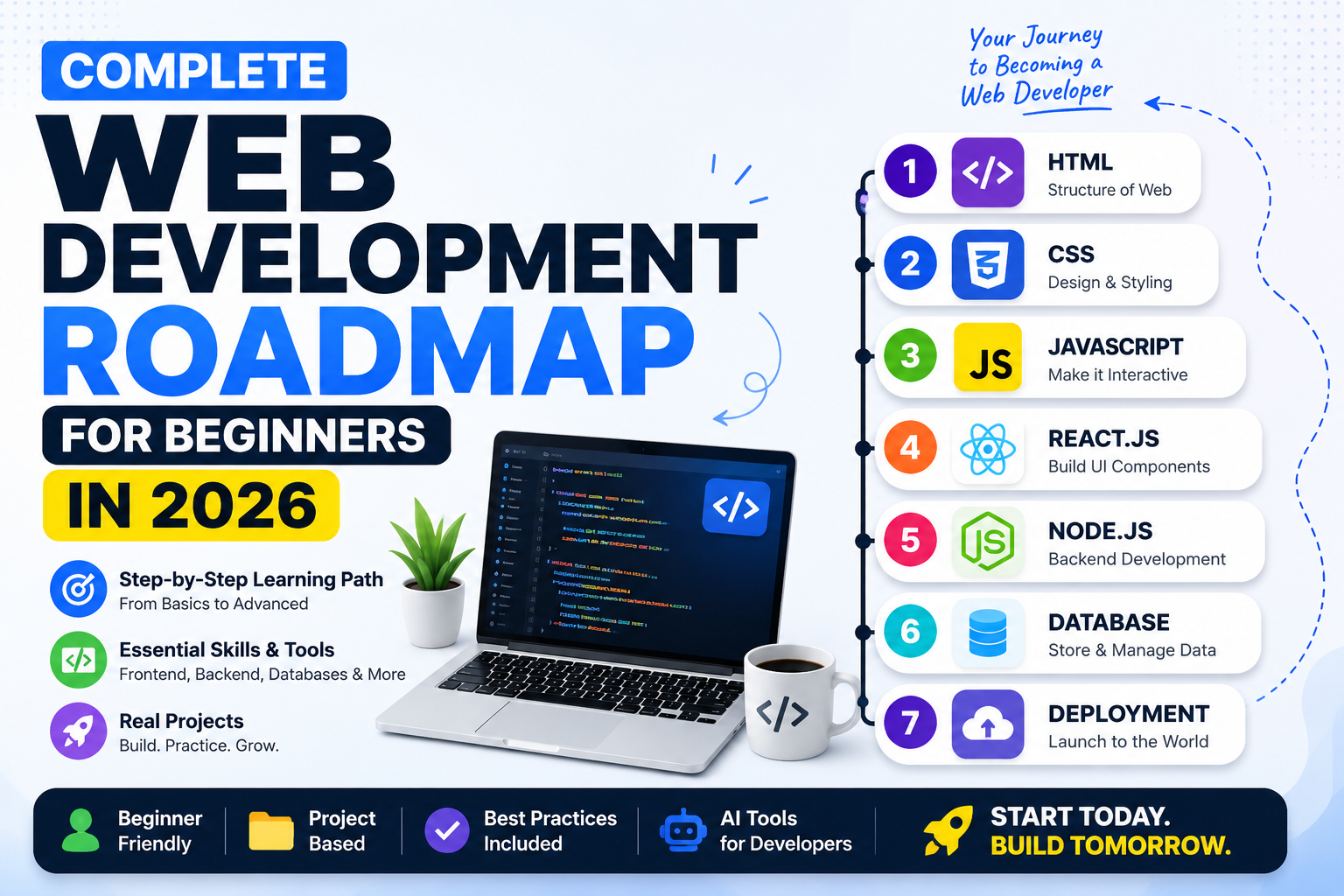
Step 2: The Non-Negotiable Foundations
Regardless of which path you choose, everyone starts here. Don't skip this stage, and don't rush it just because it looks easy.
HTML — the skeleton of every webpage. Learn semantic tags, forms, and accessibility basics (alt text, proper heading structure). This takes a couple of weeks, not months.
CSS — this is where most beginners underestimate the learning curve. Flexbox and Grid are essential; you'll use them constantly. Once you're comfortable, learn a utility-first framework like Tailwind CSS — it's become the default choice for a huge share of teams because it speeds up styling without forcing you into someone else's design system.
JavaScript — the actual engine. Variables, functions, arrays, objects, the DOM, async/await, fetch requests. Resist the urge to jump into React before this is solid. A shaky JavaScript foundation is the single biggest reason people get stuck later and can't debug their own code.
Budget roughly six to eight weeks for this stage if you're learning part-time. Build small, ugly projects along the way — a calculator, a to-do list, a quiz app. Nobody's grading you on design
Step 3: Pick Up TypeScript Early
A few years ago you could get away without TypeScript. Not anymore. Most production codebases in 2026 are written in it, and job listings increasingly assume you know it. The good news: if your JavaScript fundamentals are solid, TypeScript is mostly about adding type annotations and getting comfortable with interfaces. Give it a couple of weeks once you're past core JS.
Step 4: The Frontend Path
Once the fundamentals are in place, this is where things get fun.
Pick a framework — React is still the default. It's not the only option (Vue and Svelte both have loyal followings, and Svelte in particular has grown a lot), but React's job market share alone makes it the safest first choice. Learn components, props, state, hooks (useState, useEffect), and how to fetch and render data from an API.
Move to a meta-framework. In 2026, very few professional projects use raw React with a hand-rolled bundler setup — that era is basically over. Next.js is the standard entry point now: it handles routing, server-side rendering, and data fetching in one package, and increasingly blurs the line between frontend and backend through server actions. Learning Next.js after React isn't optional anymore; treat it as part of the same stage.
Round it out with:
- Git and GitHub (version control — not optional, ever)
- Basic testing (Vitest or Jest, plus a bit of React Testing Library)
- Responsive design and accessibility (this genuinely affects hiring — accessibility compliance has become a legal requirement in a growing number of places)
- Deployment (Vercel or Netlify — you should be able to ship a live site, not just run one locally)
Step 5: The Backend Path
If you're going full stack, or backend is your main interest, here's the sequence.
Pick a language. Node.js is the fastest path if you already know JavaScript — same language, different environment. Python is a strong alternative and pairs well if you're interested in data or AI-adjacent work later. Go is worth knowing about, but it's a second-language choice, not a starting point.
Learn Express (or a similar framework) to build APIs. Understand REST conventions properly — HTTP methods, status codes, request/response structure — before touching anything fancier like GraphQL.
Databases, both flavors:
- Relational (PostgreSQL) for structured data with relationships
- Document-based (MongoDB) for flexible, less structured data
You don't need to master both immediately, but you should understand why you'd choose one over the other, not just how to write queries.
Authentication. Learn how JWTs and OAuth work at a conceptual level, then use a managed service (Auth0, Clerk, or similar) rather than rolling your own auth system as a beginner. Security mistakes here are unforgiving.
Deployment and infrastructure basics. You don't need to become a DevOps engineer, but you should be comfortable deploying a backend to a cloud provider (Railway, Render, or AWS/GCP for something closer to industry standard) and understand what a CI/CD pipeline actually does, even if you're using a template someone else built.
Step 6: Learn to Work With AI Tools, Not Around Them
This is different advice than you'd have gotten a few years ago, so it's worth saying plainly: AI-assisted coding tools are now a normal part of the job, not a shortcut people frown on. Tools like Copilot, Cursor, and Claude are used daily by professional developers to speed up boilerplate, debug, and explore unfamiliar code.
The catch — and it's a real one — is that leaning on these tools before you understand the fundamentals will hollow out your skills. Use AI to move faster once you can read and reason about the code it gives you. If you can't explain why a piece of generated code works, slow down and learn that piece properly first. Employers can tell the difference between someone who understands their codebase and someone who's just pasting in suggestions.
Step 7: Build a Portfolio That Actually Gets Looked At
Three or four real projects beat ten tutorial clones. Aim for:
A full-stack app with authentication — a to-do app with real user accounts is a fine, honest choice; nobody expects your first project to be original
Something that consumes a public API — weather, movies, finance data, whatever interests you
A project that solves a problem you personally have — this one usually turns out best, because you actually care about it
Deploy everything, keep the GitHub repos clean, and write a README that explains what the project does and why you made the choices you did. Hiring managers skim — make it easy for them.
A Rough Timeline
If you're learning part-time (10–15 hours a week), here's a reasonable pace:
Months 1–2: HTML, CSS, JavaScript fundamentals
Months 3–4: TypeScript, React, and either Next.js or your chosen backend stack
Months 5–6: The other side of the stack (backend if you started frontend, or vice versa), plus testing and deployment
Months 7–8: Portfolio projects, polishing GitHub, applying to jobs
That's roughly eight months from zero to job-ready, not counting the job search itself, which can easily take another few months on top. Don't let that discourage you — most working developers didn't move faster than this either, whatever their LinkedIn posts imply.
The Honest Takeaway
Nobody learns web development in a straight line. You'll get stuck, rebuild the same project three times, and switch tutorials halfway through more than once. That's normal, not a sign you're bad at this. The developers who make it aren't the ones who never got confused — they're the ones who kept building through the confusion instead of waiting to feel ready.
Pick a lane, get the fundamentals genuinely solid, then build things that are a little too hard for you. That's the whole roadmap, really.